Monthly Archives: April 2017
A Glimpse into the Apollo Guidance Computer – Borja Sotomayor – Medium
Source: A Glimpse into the Apollo Guidance Computer – Borja Sotomayor – Medium
How to read FLAGORGY 🙂
Block I Apollo Guidance Computer (AGC): How to build one in your basement
The code that took America to the moon was just published to GitHub, and it’s like a 1960s time capsule — Quartz
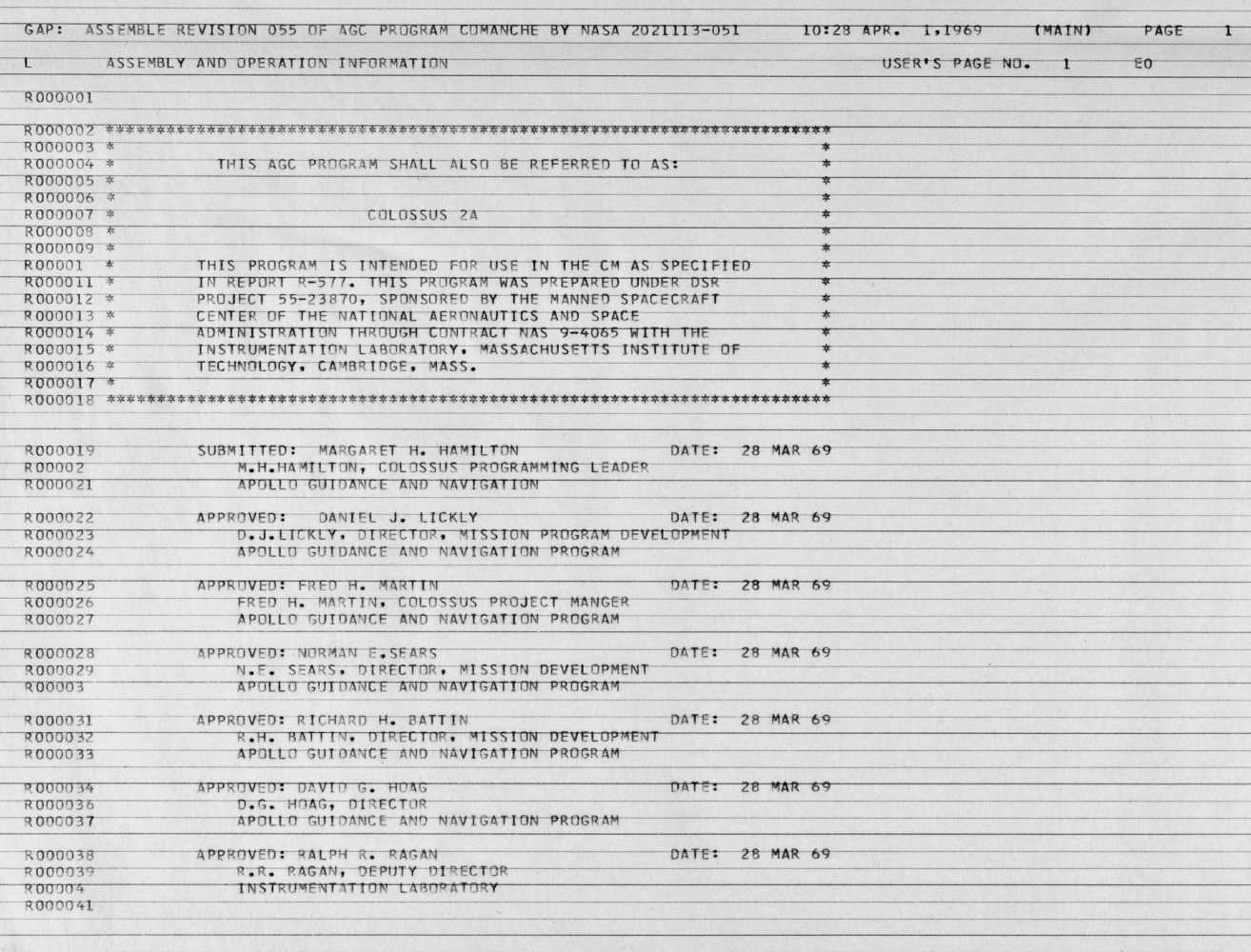
GitHub – chrislgarry/Apollo-11: Original Apollo 11 Guidance Computer (AGC) source code for the command and lunar modules.
0001.jpg (1314×1000)
Source: 0001.jpg (1314×1000)
Margaret Hamilton – Margaret Hamilton (scientist) – Wikipedia
#/media/File:Margaret_Hamilton.gif)
Counter resistance : Nature Microbiology
The Deep Space of Digital Reading – Issue 47: Consciousness – Nautilus
http://m.nautil.us/issue/47/consciousness/the-deep-space-of-digital-reading-rp
when you think about all the kinds of reading that print affords, the experience of starting a text at its beginning and reading all the way to the end, which we now associate with “deep” reading, looks less characteristic of print in general than of the novel in particular: the one kind of book in which, we feel, we might be depriving ourselves of something vital if we skipped or skimmed.
Margaret Atwood, the Prophet of Dystopia – The New Yorker
http://www.newyorker.com/magazine/2017/04/17/margaret-atwood-the-prophet-of-dystopia
The women reminisced about studying with Northrop Frye. “He is the person who talked me into going to grad school instead of moving to Paris, and living in a garret and drinking absinthe,” Atwood said. “But, Adrienne, you did move to Paris.”
“You came to visit,” Clarkson said.
“And you were painting your fingernails a beautiful shade of red,” Atwood continued.
“How frivolous of you to remember that,” Clarkson said, fondly.
“How novelistic of me to remember it,” Atwood said.
Crowd Source — The California Sunday Magazine
https://story.californiasunday.com/crowds-on-demand
If people start to doubt the veracity of crowds, his business might suffer. “Right now, we’re still kind of this secret weapon,” Adam says. “We have the element of surprise. Yeah, you might’ve heard about political candidates paying to bring some extra bodies into their campaign events, but it’s beyond the realm of most people’s imagination that crowds are being deployed in other ways. Nobody is skeptical of crowds. Of course, in five years that could change.”
NASA Open Source Software
If You Give A Cop A Pepsi… – Slog – The Stranger
Simon Fraser University kills its Indigenous education program, continuing its legacy of mismanaging Truth and Reconciliation funding: By Natalie Knight
VicPD and the BC government: Purveyors of fine Victorian fences — Needs More Spikes
Nihilism or Wonder? On the Evolution of the Alien Story | Literary Hub
At Anicka Yi’s New Guggenheim Show, the Art Smells (and Crawls)
Netflix’s biggest competition is sleep, says CEO Reed Hastings | The Independent
Barkley L. Hendricks, pioneer of Black portraiture, dead at 72 – AFROPUNK
Primavera de Filippi on Blockchain and the Quest to Decentralize Society – CoinDesk
And her findings have eventually led her to the mantra: “From competition to cooperation.””So, I think we need to come up with different governance structures which are not market-based, but which will ensure some sort of decentralized power within the community,” she said.That might turn some heads in the blockchain industry, which has historically been made up of libertarian-leaning free market supporters. But, in her mind, building a decentralized system within the confines of a market-based economy doesn’t make sense.”It’s kind of funny because there’s such an obsession with creating a decentralized system. But, if you use a market-based mechanism to govern that system, obviously it’s going to centralize itself, you know? So, what’s the point? Why are you building a decentralized system in the first place?” she said.
Source: Primavera de Filippi on Blockchain and the Quest to Decentralize Society – CoinDesk
CommandLine · pasdoc/pasdoc Wiki · GitHub
Some of Gabriel Garcia Marquez’s Best Characters Were Dead People | Literary Hub
How Passive Patience Is Oppressive – But Active Patience Could Help Us All
HyperNormalisation and the Origins of Trumpism – Film – The Stranger
How Salvador Dalí Accidentally Sabotaged His Own Market for Prints
https://www.artsy.net/article/artsy-editorial-salvador-dali-accidentally-ruined-market-prints
The turning point would come in the 1960s. Having by now occasionally pre-signed his signature on blank sheets as a way of expediting the printing process, Dalí came to understand that a print-ready sheet bearing his signature was, on its own, already worth $40. The implications were not lost on the artist. Nor on his then-secretary, John Peter Moore, who pulled down a 10 percent commission on every Dalí contract he arranged. Moore would later be singled out as the first to encourage the artist’s excesses.
“With aides at each elbow, one shoving the paper in front of Dalí and the other pulling the signed sheet onto another stack,” writes author Lee Catterall, “it was claimed that Dalí could sign as many as 1,800 sheets an hour for $72,000. The practice provided a quick way to generate payment for a hotel or restaurant bill.” Indeed, having reneged on an agreement to produce 78 tarot card illustrations for the James Bond movie “Live and Let Die,” Dalí would resort to precisely this tactic to settle his debts. Between 1976 and 1977, the artist signed 17,500 blank sheets of paper for the tarot prints that had yet to be produced.